
Sales professionals are always seeking ways of improving their chances of converting new prospects into customers. Yet many sales teams spend far more time polishing their pitch than preparing their sales discovery questions. When you treat sales discovery questions as a strategic part of the sales process rather than a formality, you change the quality and outcome of every conversation.
What This Topic Really Means
At its simplest, discovery is the part of the sales process where you ask questions and gather information. In practice, effective sales discovery questions go far beyond basic data collection. They allow you to foster understanding, build trusted advisership and align your solution with the prospect’s required outcomes.
Well designed sales discovery questions help you to:
- Clarify what the prospect is really trying to achieve.
- Understand the pains, risks and pressures that sit behind the project.
- Explore the consequences of action and inaction in a structured way.
Instead of moving quickly to a pre-prepared pitch, you slow down and use these questions to uncover the deeper picture. This gives you a much stronger foundation for any proposal you make.

Why This Matters for Irish/UK Businesses
- Decision makers in Irish and UK organisations have limited time. They expect salespeople to arrive prepared with thoughtful sales discovery questions, not generic scripts.
- Increasingly complex buying decisions mean that weak discovery leads directly to stalled deals and “no decision” outcomes.
- When different suppliers all offer similar products or services, the quality of your questions is one of the clearest ways to differentiate your approach.
- Strong discovery improves forecast accuracy because you understand real priorities, timelines and constraints rather than guessing.
- Teams that invest in better questioning generally see higher win rates, stronger relationships and fewer late-stage surprises.
Key Principles | Framework | Breakdown
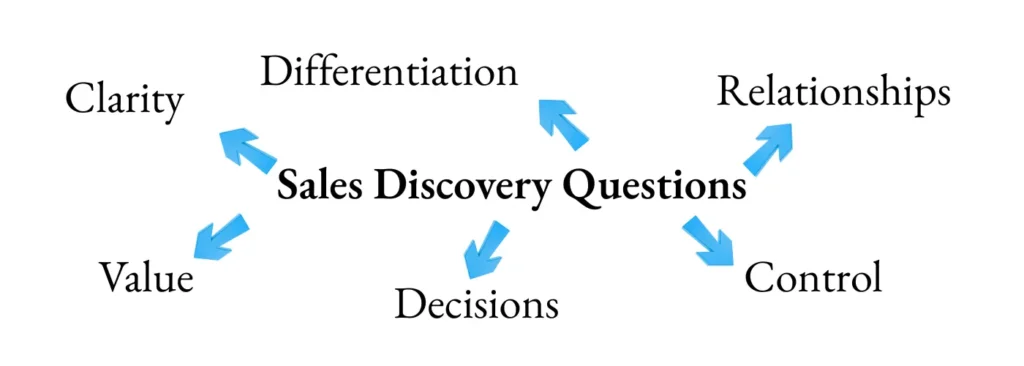
Principle 1: Clarity
Good questioning skills help prospects bring clarity to their priorities and goals. When your prospects are asked the right questions, they are made to think clearly about what they want to happen. This supports greater self-awareness and often offers fresh perspectives and insight. Clarity for the prospect creates clarity for you.
Principle 2: Better Decision Making
Well thought out questions encourage prospects to consider options that they may not have examined before. You help them explore different routes forward, recognise trade-offs and understand the consequences of their choices. Better questioning leads to better decision making, which in turn leads to more committed decisions and fewer deals that fade away.
Principle 3: Relationship Building from Day One
By showing that you have spent time crafting questions that are truly relevant, you signal that you are interested in the person, their challenges and what they have to say. When prospects feel listened to and understood, they are more likely to share more information and to trust you. Strong discovery allows you to begin building the relationship from the very first conversation.
Principle 4: Creating Value in the Conversation
When you ask insightful questions, you are not just gathering information; you are creating value by helping the customer think more deeply about their challenges. You prompt them to look at root causes rather than surface symptoms. Over time, this positions you as a trusted advisor rather than just another salesperson who arrived with a slide deck.
Principle 5: Guiding the Conversation
There is a well known truth in selling: the person who asks the questions guides the conversation. Skilled questioning allows you to lead the discussion in a direction that aligns with your sales goals while remaining centred on the customer’s needs. You can ensure that essential topics such as stakeholders, risks and success measures are covered without turning the meeting into an interrogation.
Principle 6: Differentiating Yourself
A strong questioning skill set will set you apart from your competitors. If you are asking the sort of questions that others are not, you demonstrate a higher level of professionalism and understanding of the prospect’s world. In crowded markets, the way you conduct discovery is often what prospects remember long after the meeting ends.
How Leaders Should Approach This
Sales leaders who want to improve results through better sales discovery questions need to treat questioning as a core capability, not a soft skill.
Practical steps include:
- Define what good discovery looks like in your organisation, including the outcomes every meeting should achieve.
- Work with your team to build a shared library of strong questions that reflect your market, your offer and your typical decision makers.
- Use call reviews and deal reviews to coach specifically on questioning: what was asked, what was missed and what could have been explored further.
- Embed discovery outcomes into your sales process stages so that progress is based on insight gained, not just activities completed.
- Provide ongoing training and coaching so that better questioning becomes habit, not a one off initiative.
If you would like a short, practical overview of common discovery areas and example questions, this article from Pipedrive offers a useful checklist of sales discovery questions and how to use them effectively in calls and meetings.
Common Mistakes (and How to Avoid Them)
- Treating discovery as a quick checklist instead of a structured conversation guided by strong questions.
- Jumping into the pitch after only a few superficial questions.
- Asking leading questions that obviously push towards your product rather than exploring the prospect’s real situation.
- Talking more than you listen and cutting off answers instead of probing further.
- Failing to record and use what you have learned to tailor your proposal, follow up and next meeting.
What Good Looks Like
In a strong discovery meeting, the prospect experiences the time as useful. The questions feel relevant, considered and respectful. The conversation flows naturally but has a clear structure.
Good looks like:
- The prospect has clearer understanding of their own priorities and challenges by the end of the meeting.
- You have a detailed picture of pains, desired outcomes, stakeholders and constraints.
- Both sides agree on whether there is a realistic fit and what the next step should be.
When this becomes normal practice across your team, you see cleaner pipelines, higher conversion rates and stronger, more resilient customer relationships.
How Jordan Wolf Associates Helps
At Jordan Wolf Associates, we view sales discovery questions as a practical lever for improving sales performance rather than an abstract concept. We provide sales consultancy, training, process design and coaching to help organisations embed stronger discovery into their sales approach, including cross-border sales where relevant.
We help organisations to:
- Redesign their discovery stage so that it becomes a consistent, value creating part of the sales process.
- Equip sales teams with practical questioning frameworks and example questions they can adapt to their own style.
- Provide sales training and consultative selling training programmes that place questioning and listening at the centre of the skill set.
- Deliver sales consultancy projects that align discovery, qualification and opportunity management.
- Coach individual salespeople and managers on live opportunities so that better discovery turns into better outcomes.
Our work is direct, grounded in real sales situations and focused on measurable improvements in win rates, conversion and relationship strength.
FAQs
Q1: What are sales discovery questions?
They are planned, purposeful questions that you ask early in the sales process to understand the prospect’s situation, priorities, pains and desired outcomes, rather than relying on assumptions.
Q2: How many sales discovery questions should I prepare for a meeting?
It is usually better to prepare a small number of high quality sales discovery questions and follow up on the answers than to run through a long checklist. Focus on the questions that will bring the most clarity.
Q3: Can sales discovery questions be used later in the sales cycle?
Yes. Although most discovery happens early, you can continue to use these questions at later stages to test assumptions, confirm priorities and check that your solution still aligns with what the prospect needs.
Q4: How quickly can a team improve its questioning skills?
Teams can improve quickly when they have a clear standard, a shared question library and regular coaching focused on discovery. The key is consistent practice rather than one off training.
Call to Action
Get Your Free Consultation
Why not take advantage of our 1-hour (no obligation) sales strategy consultation? We are always happy to discuss practical ways to improve sales performance, prospecting, and commercial capability.
Email: gerard@jordanwolf.ie
Phone: +353 (1) 556 3049